
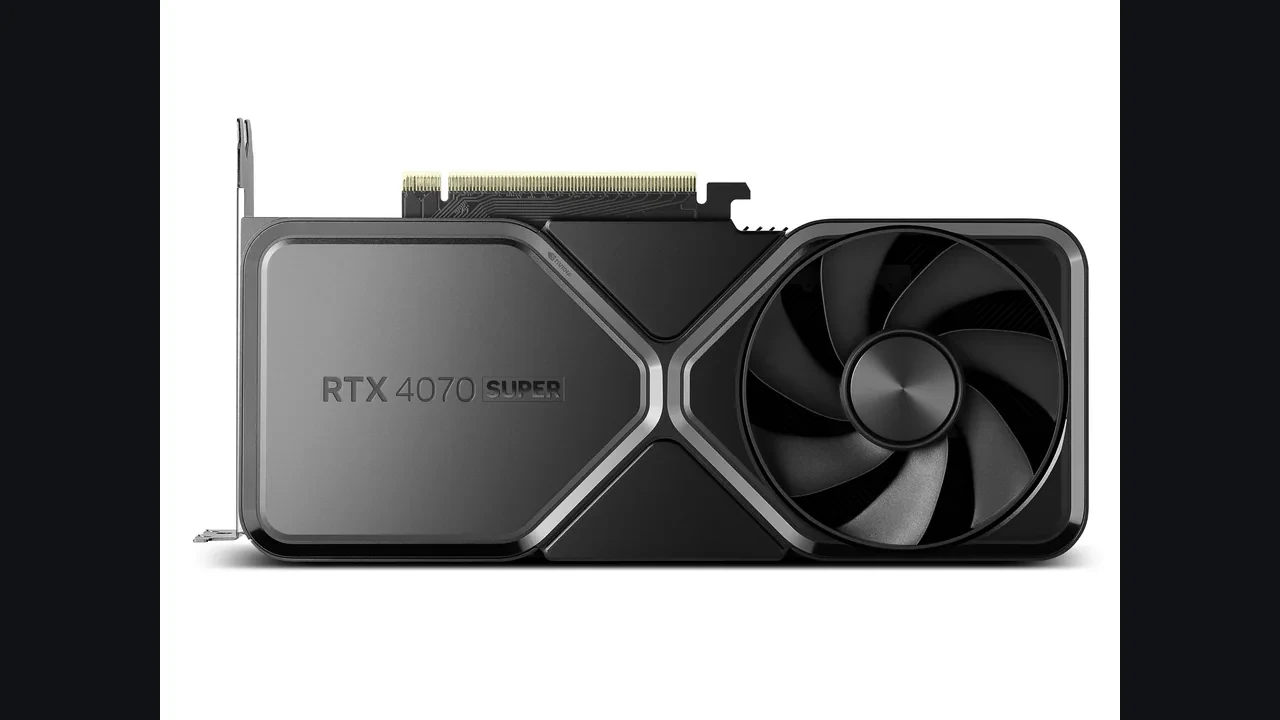
GeForce RTX 4070 SUPER DLSS 5 compatibility
No official DLSS 5 launch support has been announced for any desktop GeForce RTX 40 card, including the RTX 4070 SUPER. Its latest supported feature set is DLSS 4.5 Super Resolution, Ray Reconstruction, and Frame Generation. That decides what a 2026 build can enable, what QA must validate, and what a store page can promise.
Treat compatibility as an engineering result rather than a rumour. Keep the current renderer on DLSS 4.5 and design the integration so a later driver update changes settings and test coverage, not the whole pipeline.
What NVIDIA has published about DLSS 5
Press coverage and NVIDIA Research describe DLSS 5 as the next numbered release, but the public launch material is not yet a complete feature specification for shipping RTX 40 builds. NVIDIA has not published a compatibility list, driver schedule, or release note naming the RTX 4070 SUPER.
- “No official launch support” does not mean the feature is impossible. It means NVIDIA has not documented this GPU in the release path. Check NVIDIA’s DLSS 5 launch and compatibility material, then require a real driver or SDK changelog entry before citing support.
- “Currently supported” can change, but today’s floor is clear. DLSS 4.5 is the newest documented revision on RTX 40 desktop cards. Older integrations remain usable through largely backward-compatible SDK behaviour.
Until NVIDIA names the model, the RTX 4070 SUPER is a DLSS 4.5 target. Anything stronger risks refunds and poor review threads when the binary cannot match the store copy.
Why this card still belongs in every test matrix
The RTX 4070 SUPER is a common 1440p high-refresh choice and has the dedicated hardware required by DLSS 4.5. The same integration used on an RTX 4080 or RTX 4090 can serve it, with different quality presets rather than another renderer branch.
- It belongs to RTX 40 desktop and shares the Tensor Core and Optical Flow Accelerator generation used by DLSS 4.5 Frame Generation.
- Its VRAM and shader budget can handle 1440p with high-quality ray tracing, where Super Resolution and Ray Reconstruction have clear value.
- The tier appears in Steam and Epic hardware survey data, so regressions reach public reviews and refund tickets rather than staying inside QA.
DLSS 5 is an extra row on top of that existing work, not a reason to neglect the card.
The current DLSS 4.5 feature set
The GeForce RTX 40 desktop family supports Super Resolution, Ray Reconstruction, and Frame Generation. All three appear in released 2025 and 2026 games, can be switched independently, and carry different integration and performance costs.
| DLSS 4.5 feature | What it does | Integration cost | Best use case on RTX 4070 SUPER |
|---|---|---|---|
| Super Resolution | Reconstructs a high-resolution frame from a lower-resolution input using a neural network | Low: drop-in replacement for a temporal upscaler, exposed through the Streamline or NGX SDK | 1440p and 4K targets where native rendering exceeds the frame budget |
| Ray Reconstruction | Replaces hand-tuned denoisers with a learned denoiser for path-traced or heavily ray-traced lighting | Medium: requires a denoiser hook, ray tracing buffers, and tone-mapped HDR input | Scenes with many bounces, complex reflections, or path-traced global illumination |
| Frame Generation | Inserts an additional interpolated frame between rendered frames using Optical Flow data | Low to medium: SDK call, motion vector and depth inputs, and a fixed cadence | High-refresh targets where perceived smoothness matters more than input latency |
If DLSS 5 reaches the card, it should appear through the same modular interface. A wrapper and independent controls turn that event into a version update and validation pass.
Where DLSS sits in the render pipeline
DLSS touches output resolution, motion vectors, depth, and exposure history. A typical forward or deferred renderer follows this order:
- Render the scene between 50 and 77 percent of target resolution for Performance and Quality modes respectively.
- Generate motion vectors, depth, and exposure history for the same frame.
- Send colour, motion vectors, and depth to Super Resolution for reconstruction at output resolution.
- When Ray Reconstruction is active, process noisy ray-traced lighting through the learned denoiser before the final composite.
- When Frame Generation is active, provide the previous and current upscaled frames plus Optical Flow data to create the intermediate frame.
QA should watch for mismatched jitter, missing negative-Y motion vectors, and exposure resets that flash for one frame after a lighting transition. Those faults are independent of GPU tier and argue for one maintained pipeline rather than a speculative branch.
Checks to complete before certification
A defensible “DLSS supported” claim covers driver and SDK versions, feature combinations, scene types, and frame-time stability.
| Axis | What to check | Pass condition |
|---|---|---|
| Driver and SDK version | Confirmed against a published NVIDIA driver release note and the Streamline or NGX SDK changelog | Version string matches the team’s compatibility sheet and reproduces a known reference scene |
| Feature combinations | All four modes of Super Resolution (Ultra Performance, Performance, Balanced, Quality) with and without Ray Reconstruction and Frame Generation | No crashes, no stuck black frames, and no visual regression versus the native 1080p reference |
| Scene coverage | Indoor, outdoor, particle-heavy, and motion-heavy scenes plus a worst-case stress scene with fast camera turns | No ghosting, no persistent smearing, and no path-traced lighting flicker |
| Frame-time stability | One-percent low and 0.1-percent low frame times over a five-minute capture | Frame times stay within the team’s published budget for the chosen quality preset |
Keep the driver, flags, and test scene in the QA ledger. When a support ticket arrives, the answer should come from that record.
If NVIDIA adds support later
The current status is “not officially supported.” NVIDIA is expected to publish a compatibility list when DLSS 5 ships; if the official compatibility material adds the RTX 4070 SUPER with a driver flag, most remaining work is validation. If the model is absent, keep DLSS 4.5 and point players to the published list.
- Keep NVIDIA calls behind a thin engine wrapper so a new SDK is a version bump rather than edits throughout the renderer.
- Expose quality preset, Ray Reconstruction, and Frame Generation separately so one feature can be disabled after a driver regression.
- Track driver and SDK notes in the same issue system as engine upgrades, tagged by GPU tier.
- Gate every DLSS 5 marketing statement on a public compatibility entry for the target GPU.
Store pages and patch notes need exact wording
Players look for their specific GPU and feature combination. “DLSS supported” is too vague. For a 2026 RTX 4070 SUPER build, a defensible line is: “DLSS 4.5 Super Resolution, Ray Reconstruction, and Frame Generation on GeForce RTX 40 series GPUs.” Name RTX 30 support separately if the game includes it.
Patch notes should identify the driver, feature, and GPU tier. “Fixed Frame Generation flicker on GeForce RTX 4070 SUPER with driver 5xx.xx” helps a reader. “Improved DLSS stability” does not. Keep menu labels consistent with the store page.
Limits of this guidance
- No official DLSS 5 launch support has been announced for the GeForce RTX 4070 SUPER. DLSS 4.5 Super Resolution, Ray Reconstruction, and Frame Generation remain current.
- No DLSS 5 frame-rate, scaling, or quality score is projected for this card. Such figures require a named driver, SDK, scene, and preset.
- The scope is the desktop RTX 4070 SUPER. Laptop RTX 40, RTX 30, RTX 50, Max-Q, Ti, and other SUPER products require separate validation.
- Unpublished DLSS 5 details are not confirmed. If an official list changes the status, update the store page and QA matrix before shipping the next build, then call out the change in patch notes.
The 2026 build decision
Keep the RTX 4070 SUPER in the hardware matrix because of its install base. Ship DLSS 4.5 through Streamline or NGX, wrap the SDK, and leave DLSS 5 out of public copy until NVIDIA names the card. Validate driver versions, feature combinations, scene types, and frame-time stability, then make the menu, patch notes, and store listing say the same thing.
If support arrives, the wrapper limits the work to configuration and testing. If it does not, the DLSS 4.5 route and existing documentation remain valid.
Frequently asked questions
Does the GeForce RTX 4070 SUPER support DLSS 5 right now?
No. NVIDIA has not announced launch support or published a list containing the card. DLSS 4.5 remains the production target.
What is the latest DLSS version available?
DLSS 4.5, including Super Resolution, Ray Reconstruction, and Frame Generation. The engine can switch those three features independently.
Can a game use Frame Generation?
Yes. The integration needs matching motion vectors, depth, exposure history, and Optical Flow inputs. With those in place, Frame Generation can improve perceived smoothness at 1440p high refresh.
Will a future driver add DLSS 5?
It may, but no official support has been announced. Wait for a public compatibility list or driver note before promising it.
How do DLSS 4.5 and DLSS 5 differ for developers?
DLSS 4.5 is the shipping RTX 40 feature set with documented presets and SDK calls. DLSS 5 is a future revision whose complete feature surface, presets, and GPU list are not yet documented for released builds.
Does DLSS 4.5 require a specific driver?
Yes, the SDK and driver must expose the features. Pin the validated pair in the compatibility sheet, reproduce a reference scene, and publish the driver version in store and patch material.
Should a store page list DLSS?
Yes, but name DLSS 4.5 and its three supported features. Keep that wording identical in the store, game menu, and patch notes.
What happens to DLSS 4.5 when DLSS 5 launches?
Existing Super Resolution, Ray Reconstruction, and Frame Generation calls are designed to remain usable. A later SDK can add new controls through the same pipeline.
Is the RTX 4070 SUPER the same as the RTX 4070 for DLSS?
They share the RTX 40 Tensor Core and Optical Flow Accelerator generation, so current feature support is the same. Performance, VRAM headroom, and preset tuning still require separate QA.
What is the safest integration for a 2026 build?
Use a thin SDK wrapper, independent feature controls, and a per-GPU QA matrix covering driver version, combinations, scene types, and frame-time stability.
Leave a Reply