
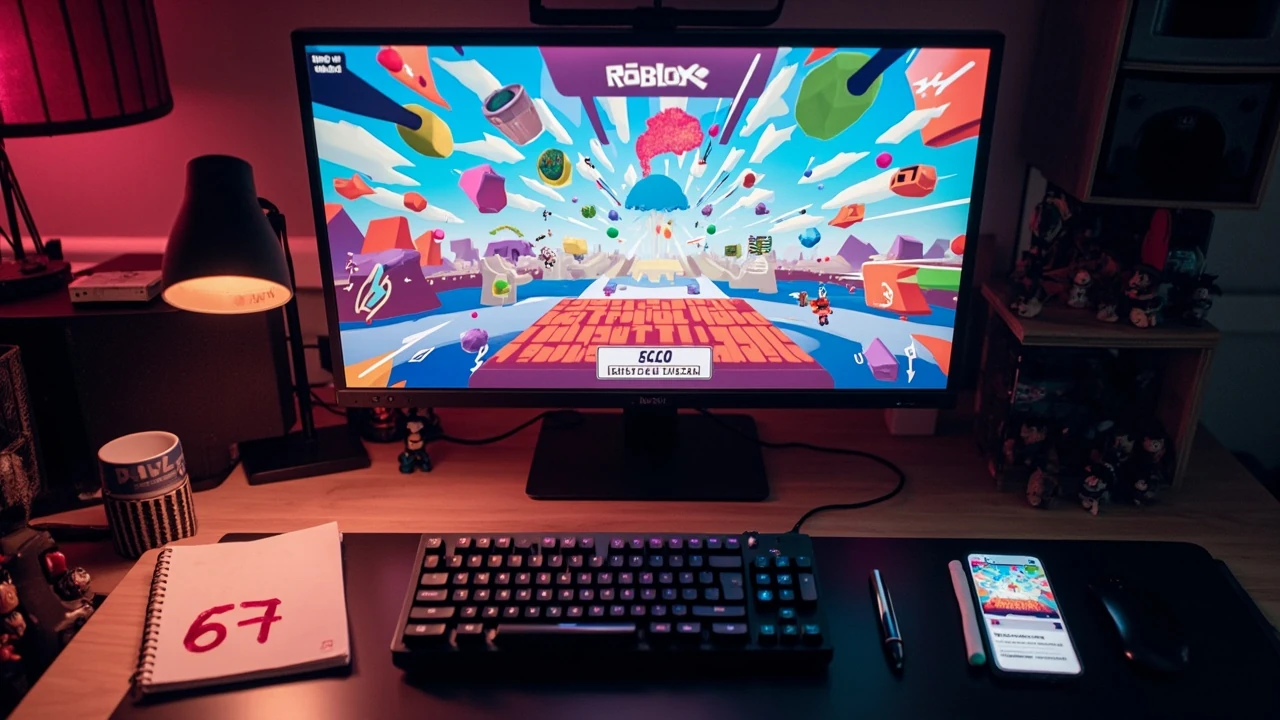
67 brainrot: separating meme hype from game design signal
67 brainrot is a useful case study in how short-form meme culture feeds back into game design. This article walks through what the term refers to, where the number and the brainrot framing come from, how the crossover into actual playable games works, and what the practical lessons are for anyone shipping or maintaining a game that targets a young, online audience. The goal is a working mental model of the trend, the production decisions it implies, and the limits of the comparison, so you can decide whether and how to respond to it.
What 67 brainrot refers to
67 brainrot is a hybrid phrase that combines two distinct internet cultural layers. The first layer is the brainrot aesthetic, a label applied to a wave of low-resolution, intentionally absurd meme characters and catchphrases that spread through short-form video platforms. The second layer is the number sixty-seven, which has acquired a specific in-group meaning in certain Roblox communities and adjacent social media circles. Combined, the phrase functions as community shorthand: it signals familiarity with a particular scene rather than describing a single game, character, or product.
For readers outside the originating communities, the safest working definition is this: 67 brainrot describes the intersection of brainrot-style surreal humor and the number sixty-seven as used inside a subset of Roblox experiences and the TikTok fanbase that surrounds them. It is not a published game, a trademarked franchise, or an officially branded genre. It is a community term that has gained enough reach that general-audience players, parents, and developers are starting to ask what it means.
The two halves of the phrase
Treating the phrase as two pieces helps clarify what is going on. Brainrot, in the meme sense, refers to content that is repetitive, low-effort on the surface, and designed to lodge in the viewer’s head through sheer repetition. Italian brainrot specifically refers to a sub-wave of that aesthetic that uses distorted Italian-sounding names, surreal hybrid animal-object characters, and exaggerated captions. The number sixty-seven, in the contexts where 67 brainrot appears, is usually a callback to an in-game action, a creator’s catchphrase, or a running joke inside a specific community. Neither half is tied to a single canonical source, which is part of why the phrase keeps mutating.
Why the crossover matters for games
The reason game developers and producers are paying attention is not the meme itself but the pattern it illustrates. Short-form video platforms have become a primary discovery surface for free-to-play and Roblox-style games. Memes act as the connective tissue between a player’s first sighting of a game and the moment they decide to open it. A phrase like 67 brainrot, even if it sounds meaningless out of context, is the kind of inside joke that pulls a viewer from passive scrolling into active play. Understanding that mechanism is more useful than memorizing the phrase.
Where the number sixty-seven came from
The number sixty-seven did not arrive with a single announcement. It accumulated meaning through a long tail of community moments, primarily inside Roblox experiences that lean on absurdist humor and rapid-fire content. The number is a small, easy-to-type token that is short enough to use as a username, a room code, a score milestone, or a clip title, which makes it convenient for both creators and players. That practicality is part of why it has persisted where longer, catchier phrases have faded.
From a game design perspective, a number like sixty-seven is interesting because it is a content-agnostic symbol. The same string can be a leaderboard rank, a collectible count, a secret code, or a punchline. That flexibility is what allowed it to be adopted by multiple communities, each of which layered its own meaning on top. When you see 67 brainrot used in the wild, the most reliable reading is that the author is signaling membership in one of those communities rather than referencing a single canonical event.
Numbers as meme tokens
Numbers have a long history of doing this work in gaming culture. Combinations like 360, 420, 666, and 1337 have all carried scene-specific meaning that can be read in milliseconds by an insider and that looks like noise to an outsider. Sixty-seven fits the same pattern, with the added twist that it is not a broadly recognized number outside the communities that adopted it. That makes it more useful as an in-group marker and less useful as a general reference, which is one reason you will see it clustered in specific platforms and age groups rather than spread evenly across the gaming population.
Where the brainrot aesthetic came from
The brainrot label has been applied to a wide range of internet content, but the specific visual and sonic style most players associate with the word traces back to a wave of surreal, intentionally low-fidelity meme imagery that took off on TikTok and YouTube Shorts between 2023 and 2025. The hallmarks include distorted or AI-generated character art, exaggerated captions in oversized text, sound bites that loop on a single syllable, and a general sense that the content was not made to be admired but to be reacted to. Italian brainrot, the sub-wave most relevant to the phrase 67 brainrot, layers on Italian-sounding names and a stable cast of recurring surreal characters.
For analyzing 67 brainrot, the important point is that the brainrot aesthetic is a delivery mechanism, not a content category. It can be wrapped around almost any subject: animals, food, objects, game characters, or abstract numbers. Its job is to lower the barrier to engagement. A viewer does not need context to react, and that is the point. When the same aesthetic gets attached to a number like sixty-seven, the result is a piece of cultural content that travels further than a traditional reference would because it requires almost no prior knowledge to feel like a joke.
Italian brainrot as a specific sub-wave
Italian brainrot is the specific branch of the brainrot aesthetic that uses Italian-style names, captions, and character designs. The sub-wave became commercially significant enough to license into collectible card products distributed through Italian newsstands, with Skifidol-branded cards reported in Italian press as a notable example. That licensing milestone is useful for developers because it shows content that started as ephemeral TikTok clips can be formalized into a product category, which in turn changes how players expect to interact with it inside games.
How 67 brainrot crosses over into actual games
The phrase “67 brainrot” has been showing up in TikTok captions, Roblox lobbies, and Discord servers, and it has started crossing over into developer conversations. It borrows the visual language of the Italian brainrot wave, attaches the number sixty-seven, and turns the whole package into a kind of ironic badge. For a working game developer, producer, or designer, the interesting question is not whether the meme is funny. It is what the trend reveals about how short-form content shapes player expectations, why certain numbers and phrases stick, and how studios can read those signals without chasing every wave.
The crossover from meme to game usually happens through one of three paths. The first is the player-driven path, in which a community of players adopts a phrase or visual inside a game and starts creating their own clips, skins, and rooms around it. The second is the creator-driven path, in which a Roblox or UGC developer notices the trend and ships an experience that leans into it directly. The third is the official path, in which a larger studio notices the cultural moment and either commissions a crossover, creates a limited-time event, or files a takedown.
67 brainrot currently lives mostly in the first two paths. The phrase appears in Roblox experience titles, in TikTok captions attached to Roblox clips, and in Discord server names and emoji. There is no major publisher driving the trend from the top, and that has implications for how durable it is. Player-driven and creator-driven trends tend to spike and recede within weeks, while officially licensed trends can last longer because they get reinforced by marketing spend and platform features. If you are evaluating whether to invest in the trend as a developer, that distinction matters more than the specific phrase.
What the crossover looks like in a Roblox context
Inside Roblox specifically, the 67 brainrot pattern usually shows up as an experience title that combines the number and the aesthetic, a thumbnail that leans on the brainrot visual language, and a gameplay loop that is short, repeatable, and easy to clip. The loop is often a variant of a reaction game, an obstacle course, or a social roleplay space. The point of the experience is not novel mechanics but recognizability. A player who has seen the trend on TikTok should be able to tell within the first three seconds that this is the experience the trend refers to. That compression of context is the entire product strategy.
Why this matters for game developers and producers
For a working developer, the most useful frame for thinking about 67 brainrot is not “should I make a game about this” but “what does the existence of this trend tell me about my audience.” A few practical lessons stand out. First, short-form video platforms have become the de facto marketing layer for free-to-play and Roblox-adjacent games, and the content that travels is often the most compressed, most repetitive, and most meme-shaped. Second, in-group tokens like the number sixty-seven are an efficient discovery mechanism because they are short, copyable, and recognizable to the right audience. Third, the line between a meme and a product category is thinner than it looks, which means a trend that looks ephemeral can be commercialized faster than a traditional licensing cycle would allow.
None of those observations require you to actually ship a 67 brainrot-themed experience. For additional context, They are general lessons that apply to any meme-driven crossover. If your game is in a genre that competes for the same audience attention, the trend is a useful source of data about how that audience reads, reacts, and converts.
Production and design considerations if you respond to the trend
Once you decide that responding to a meme-driven trend is on the table, the work shifts from cultural reading to production discipline. The decisions below are not specific to 67 brainrot. They are the decisions any meme crossover forces, and getting them right is the difference between a timely response and a brand-damaging misstep.
Audience fit and age rating
The first decision is whether the trend is appropriate for your rated audience. Brainrot content in general skews young, leans on distorted imagery, and often includes rapid flashing, loud audio, and absurdist humor that may not fit every rating board’s expectations. Before you commit art, audio, or copy to a meme crossover, run the trend past your compliance lead and check the relevant platform guidance. A clip that is acceptable on TikTok is not automatically acceptable in a rated game experience, and the cost of a failed age-rating review is much higher than the cost of skipping a trend.
Asset sourcing and IP exposure
The second decision is where the assets are coming from. Brainrot-style imagery is often AI-generated or sourced from a long tail of independent creators, and the licensing status of any given character, sound, or phrase is not always clear. If you ship an experience that uses a character design lifted directly from a TikTok clip, you are exposed to a takedown, a re-skin, or a public relations problem. The safer path is to either license through a known rights holder, build original assets in the same visual language, or limit the use of the trend to text and naming rather than core art. The Italian press coverage of the Skifidol card line is one example of how rights can be formalized; if you cannot find an equivalent rights holder for the specific asset you want to use, that is information.
Gameplay loop and replay value
The third decision is the gameplay loop. Meme-driven games live or die on whether the core loop is fun after the meme has been explained. The audience that arrives from TikTok is not loyal to the meme itself. They are loyal to a small set of feelings: the ability to clip a moment, the ability to surprise a friend, and the ability to feel like they are in on the joke. If your gameplay loop does not produce those moments consistently, the meme will not save it. Plan for a loop that is short, replayable, and easy to capture, and design at least one failure state that is funny rather than frustrating, because the clip economy runs on reactions.
Operational readiness
The fourth decision is operational. Trends have short half-lives, and the cost of standing up a live experience, supporting it through its peak, and then sunsetting it without leaving a graveyard of broken experiences in your portfolio is real. Make sure you have a plan for content moderation, a clear deprecation path, and a realistic budget for community management during the spike. Trends also attract impersonators, copycats, and low-effort clones, so spend some time thinking about how players will find your official experience versus the dozens of clones that will appear within days of your launch.
Common mistakes when chasing meme trends
Developers who respond to meme-driven trends without preparation tend to repeat a small set of mistakes. Listing them explicitly is useful because the failure modes are predictable and avoidable.
- Assuming the meme is universally recognizable. A phrase that is obvious inside one community can read as nonsense to a general audience, and shipping a game that depends on shared context you do not actually have is a common cause of poor conversion.
- Confusing reach with retention. A viral clip can deliver a spike of installs, but if the game’s day-one retention is unchanged, the spike is wasted spend. Measure the trend’s effect on retention, not just on top-of-funnel metrics.
- Shipping without a moderation plan. Meme trends attract users who are testing the edges of the rules, and a moderation gap shows up quickly in reviews, in platform compliance reports, and in player churn.
- Letting the meme override the game’s identity. A single trend-led experience can rebrand your studio in the minds of players in ways that are hard to walk back. Decide in advance how much of your studio’s surface area you are willing to spend on a trend.
- Ignoring the rights picture. The legal exposure of using meme-sourced assets can be larger than the marketing upside. If you cannot find a clean rights path, the answer is usually to build something original in the same spirit rather than to copy the meme verbatim.
How to evaluate a trend like 67 brainrot before committing
A simple evaluation framework is useful when a new phrase shows up repeatedly in your team chat and you have to decide whether to act. The table below summarizes the main axes, the questions to ask on each axis, and the signals that suggest the trend is worth a measured response. The wording in the right column is illustrative, not a benchmark; the goal is to give your team a shared vocabulary for the decision rather than a single score.
Trend evaluation matrix
| Axis | Question to ask | Strong signal of opportunity | Strong signal of risk |
|---|---|---|---|
| Audience fit | Does the trend’s natural audience overlap with our target demographic? | Overlapping age range, platform, and tone | Audience skews much younger or much older than our rated experience |
| Asset rights | Can we license or rebuild the core assets cleanly? | A clear rights holder or a clean rebuild path | Mixed provenance, no rights holder, heavy AI use with unclear license |
| Gameplay fit | Does our core loop support a meme-shaped experience? | Existing loop is short, clip-friendly, social | Loop is long-form, single-player, or requires deep narrative context |
| Operational cost | Can we support the experience through its peak and deprecate it cleanly? | Existing moderation, analytics, and sunset tools | No deprecation plan, no moderation capacity, no analytics on the audience |
| Brand risk | Will the trend damage the studio’s longer-term identity if we participate? | Trend matches existing brand tone or audience expectations | Trend conflicts with rated content, publisher relationships, or audience trust |
| Time to market | Can we ship inside the trend’s natural half-life? | Experience can be live in days using existing systems | Trend will be cold before we can ship a compliant build |
Using a table like this forces the conversation onto specific, testable claims rather than gut feeling. If the team cannot fill in the strong-signal column for at least four of the six axes, that is usually a sign that the trend is not worth a near-term commitment, even if it is worth keeping on the watchlist.
Where 67 brainrot sits in the broader brainrot landscape
One reason the phrase confuses outsiders is that the brainrot label is being applied to many different things at once. The table below distinguishes the main categories of content that get called brainrot, with rough descriptions of their visual language, their typical platform, and the kind of game crossover they tend to produce. The categories are not strict, and content often blurs between them, but the distinction is useful when you are trying to figure out which kind of brainrot you are actually looking at.
Brainrot sub-wave comparison
| Sub-wave | Visual style | Typical platform | Game crossover pattern |
|---|---|---|---|
| Generic brainrot | Low-fi, distorted, fast-cut, repetitive | TikTok, YouTube Shorts | Background aesthetic for creator-led Roblox experiences |
| Italian brainrot | Italian-sounding names, hybrid animal-object characters | TikTok, plus licensed card products | Collectible and character-led experiences, sometimes officially licensed |
| Number brainrot (including 67) | Text-led, minimal imagery, often a number plus a phrase | Roblox, Discord, TikTok captions | Experience naming, room codes, in-game tokens, clip titles |
| Audio brainrot | Short looping sound bites, often a single syllable | TikTok, in-game voice chat | Sound packs, emotes, voice-line crossovers |
The 67 brainrot pattern falls squarely in the number brainrot row. That is useful because the production requirements for a number-led crossover are different from the requirements for a character-led or audio-led crossover. A number-led experience can usually be built faster, with less asset risk, and on a tighter timeline, but it also has less visual surface area to anchor a brand. Decide which trade-off matches your studio’s appetite before you commit.
Player perspective: what 67 brainrot feels like from inside the audience
It is easy to analyze a trend from the outside and miss what it actually feels like to be a participant. Players who are deep in the 67 brainrot scene are not thinking about meme theory. They are using the phrase as a quick way to flag content they want to see, to mark themselves as part of a community, and to compress a long piece of context into a few characters. When a player types “67 brainrot” into a search bar, they are usually looking for one of three things: a clip they can react to, an experience they can join, or another player they can share the joke with.
That functional reading is what makes the trend sticky. It is not trying to be clever. It is trying to be fast, recognizable, and slightly transgressive. A developer who responds to the trend by overthinking the cultural theory is likely to miss the point, while a developer who designs for the functional reading is more likely to ship something the audience actually wants.
What the audience is signalling with the phrase
When a player uses 67 brainrot, they are signalling several things at once. They are signalling that they are aware of the underlying brainrot aesthetic. They are signalling familiarity with a specific community in which the number sixty-seven carries meaning. They are signalling that they are part of an in-group that can read the phrase without explanation. And they are signalling a preference for content that is short, repeatable, and easy to share. Reading those signals is more useful than reading the literal words, because the literal words are almost always less informative than the social context they are pointing at.
Risks for studios and publishers
Responding to a meme trend is not free of downside, and the risks fall into a few predictable categories. The first is reputational risk: a studio that is known for serious or narrative-driven work can damage its brand by shipping a meme-led experience that does not match player expectations. The second is compliance risk: a meme experience that runs into age-rating or platform-policy issues can cost more in remediation than it ever earns in revenue. The third is operational risk: a trend can spike and recede faster than your team’s ability to support it, leaving a broken experience in the live catalog. The fourth is rights risk: the licensing status of meme-sourced assets is often unclear, and the cost of a rights dispute can dwarf the marketing benefit.
None of these risks are unique to 67 brainrot. They apply to any meme-driven crossover, and they are the reason a careful studio will often choose to watch a trend rather than participate in it. There is no rule that says you have to respond to every wave. Sometimes the correct decision is to let the trend run its course and use the time to learn how your audience reacts to similar waves in the future.
When to participate and when to wait
A useful heuristic is to compare the trend’s audience to your studio’s existing audience, and the trend’s asset style to your studio’s existing asset style. If both comparisons line up, participation is usually low risk and worth testing. If either comparison is off, the cost of participating is higher than the cost of waiting. If both are off, the trend is probably not for your studio, no matter how loud it is. The phrase “67 brainrot” itself is unlikely to matter to a single-player narrative studio, while a Roblox developer whose audience already lives in the brainrot aesthetic has a much shorter path to a relevant response.
Frequently asked questions
What is 67 brainrot in simple terms?
67 brainrot is community shorthand that combines the brainrot meme aesthetic with the number sixty-seven, used mostly inside a subset of Roblox experiences and the TikTok fanbase that surrounds them. It is not a single game, franchise, or product. It is a phrase that signals familiarity with a particular online scene and a preference for content that is short, repeatable, and easy to clip.
Is 67 brainrot a specific game?
No. There is no single canonical game called 67 brainrot. The phrase appears in many Roblox experience titles, in TikTok captions attached to Roblox clips, and in Discord server names, but each instance refers to its own experience or community moment. Treating the phrase as a single product is the most common source of confusion for people who first encounter it.
Where did the number 67 come from?
The number sixty-seven accumulated meaning through a long tail of community moments inside Roblox-adjacent communities, rather than arriving with a single announcement. It is short, easy to type, and flexible enough to use as a username, a room code, a score milestone, or a clip title, which is part of why it has stuck where longer phrases have faded.
How is 67 brainrot different from Italian brainrot?
Italian brainrot is a specific sub-wave of the brainrot aesthetic that uses Italian-sounding names and surreal hybrid character designs. 67 brainrot is a separate pattern that lives mostly in number-led community shorthand. They share the same broad aesthetic family, but they show up in different content types and call for different production responses.
Should a developer make a game about 67 brainrot?
Only if the trend’s audience, asset style, and gameplay expectations line up with your studio’s existing capabilities and brand. For most studios, the more useful response is to read the trend as a signal about how the audience discovers and reacts to games, rather than as a specific product to ship. If you do choose to participate, the safest path is original assets in the same visual language, with a clear rights review and a realistic deprecation plan.
Is 67 brainrot appropriate for kids?
It depends on the specific experience and on the platform’s age-rating system. The broader brainrot aesthetic often relies on distorted imagery, rapid flashing, and loud audio, which can be uncomfortable for some players and may interact poorly with certain rating guidelines. Any studio building in this space should run the trend past a compliance lead before shipping, and parents should treat the phrase the same way they would treat any unfamiliar online trend: by checking the specific experience rather than the label.
Why do trends like this matter to non-Roblox studios?
Even if your studio does not work in Roblox, the trend still matters because it illustrates how short-form video platforms have become the primary discovery surface for free-to-play and youth-skewing games. The lessons about compressed context, in-group tokens, clip-friendly loops, and rapid asset decisions apply to almost any studio competing for that audience’s attention.
How long does a trend like 67 brainrot usually last?
Player-driven and creator-driven trends typically have short half-lives measured in weeks, with a longer tail of community usage that can run for months. Officially licensed or formally commercialized versions of a trend can last longer because they get reinforced by marketing and platform features. Plan for a fast spike and a graceful sunset unless you have specific evidence that the trend has crossed into a more durable category.
Can a studio safely ignore 67 brainrot?
Yes. Ignoring a single meme trend is a perfectly reasonable decision, and most studios will never need to respond to 67 brainrot specifically. The more useful discipline is to keep a watching brief on the broader brainrot landscape so that if a related wave crosses into your audience, you have a frame for evaluating it rather than having to invent one under deadline.
Where can I read more about the broader brainrot trend?
The English-language Wikipedia article on memes is a reasonable starting point for the cultural context behind phrases like 67 brainrot, and the Italian press coverage of the Skifidol card line linked earlier covers the commercial formalization of one related sub-wave into collectible cards. Neither source is a substitute for direct observation of the communities where the phrase actually lives, but both are useful background for understanding why the trend spread the way it did.
Leave a Reply